
Do your students struggle to make connections between domain, range, and other related terms when graphing linear equations?
#1 – Domain and Range with Graphs in Algebra1
First, it isn’t uncommon to discover that students struggle to conceptualize domain and range with graphs in Algebra1.
- 1. Function
- 2. Domain
- 3. Range
- 4. Mapping
- 5. Input, x
- 6. Output, y
In addition, some students may still struggle to understand the connection between t-charts, listed ordered pairs, and how an equation is related to a line on the graph. I like to start by defining a function as a machine. Once students visualize a function, they are visually able to make connections between it and the other terms used.
#2 – The Function
Input, Machine Function, Output
Start by discussing the functions of various everyday machines. Add that each type of machine follows a set of rules.
For example, consider a food processor used to make a salad. I want grated carrots. Next, the grater disk is positioned on the machine. The whole carrot is put it IN the machine, and the machine’s rule is to grate the carrot. OUT comes grated carrots.
Notice that I did not get sliced carrots. Why? The machine was set up to carry out a specific rule: grate.
Furthermore, explain that the linear equation is the machine. The x value represents the INPUT. The Y value represents the output. Likewise, in the carrot example, the WHOLE carrot was the x value, and the GRATED carrot was the y value.
X and Y Variables with Linear Equations: Graphs in Algebra1
Now, help students visualize a function related to a linear equation, such as y = x + 2, using a t-chart to record input and output values, x and y. Next, students plot the line. Practice several of these equations. Emphasize that the x values represent the domain and the y values represent the range.
#3 – Mapping
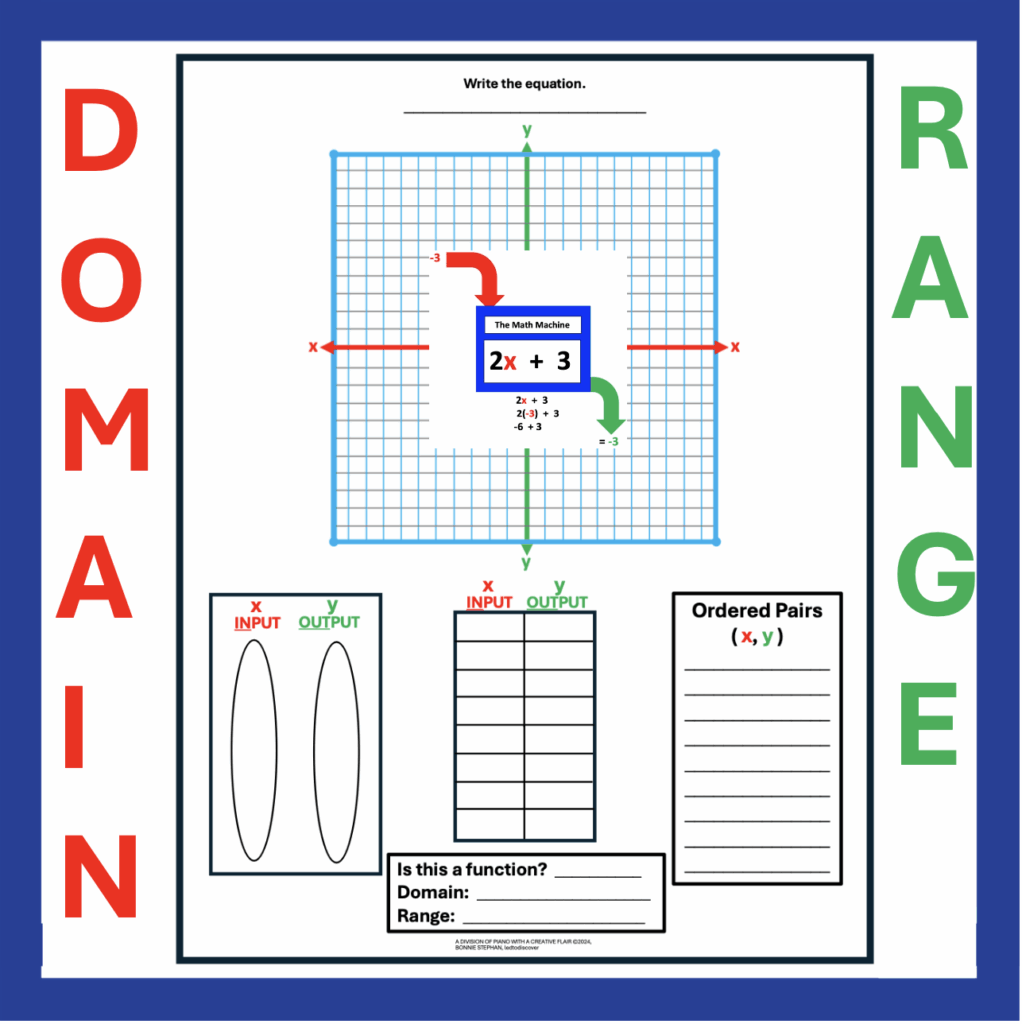
Next, help students visualize the relationships shared between t-charts, ordered pairs, and mapping. Though both represent x (domain) and y(range) values, some students do not always understand how to interpret mapping diagrams. By using visuals that include these characteristics, students are able to se the relationships between.
#4 – Resources
Furthermore, visual examples that illustrate and use these terms help students to integrate these concepts. Below are such resources.
Description
Graphic Organizers, Posters, Blank Pages, equation, graph, mapping, x/y charts, ordered pairs, domain and range, functions, Print and Go! 11 pages
Conclusion
In conclusion, by starting with familiar examples and applying these examples to linear equations with visualizations, students are able to make sense of domain and range.
Looking for More Materials?
Click the button below to view more of my educational resources!