
Do your students struggle with multiplication facts for high school math?
#1 – Our Experience
First, it would stand to reason that students should know their basic multiplication facts by the time they reach high school. On the other hand, you would likely run out of hands to name the number of students who lack this skill every year. You are not alone. Keep reading to discover a strategy that not only helps students learn basic multiplication facts but also prepares students for future Algebra topics.
#2 – Flash Cards? No!
Why?
Second, we must remember to be subtle in our approach to teaching multiplication facts in high school, as flash cards may remind students of elementary school instruction. Due to this, we must find alternative methods for helping struggling students learn alongside their peers. What should we do instead?
Factors: Subtle Multiplication Facts for High School
Third, let’s consider factors. You will find the following alternative method successful for not only helping students who struggle with multiplication facts, but also providing the whole class a solid foundation for factoring polynomials and simplifying roots. How many times do we begin teaching either of these Algebra topics and lose students when factoring a trinomial and the third term is c = 87? How many of our students assume 87 is prime?
#3 – How to Approach: Multiplication Facts for High School
Fourth, it is important to get a buy-in from students that the ability to factor numbers is important. Though you know there are students in your class who do not know all basic multiplication facts, it is important to approach student knowledge from a positive perspective. See below:
- 1. “As we begin this school year (semester), we will briefly review factors of numbers to prepare you for the Algebra topics we will cover this year.
- 2. “You already know how to factor numbers.” Next, give an example.
- 3. “Let’s list the factors of 12.” List the factors vertically.
1, 12 “One times twelve.”
2, 6 “Two times six.”
4, 3 “Four times three.” - 4. “You also know how to find the square root of 25 = 5. This year, you will use factors to help you simplify numbers such as 24. Notice that the number 24, itself, does not result in a perfect square. like 25.”
- 5. Now provided students with an opportunity to factor various numbers.
Easy: 16 Medium: 48 Challenging: 87
You may notice that a certain number of students will argue that 87 is prime. This is why we review factors with the whole class.
#4 – How to Practice
Next, provide students with practice. Begin with numbers that include factors that easily break in half, such as 12, 24, and 48. Write all factors in vertical alignment. Show students patterns for these numbers.
- 24 Point out the following: Numbers on the right double. Numbers on the left split in half.
1, 24
2, 12
4, 6
8, 3
Likewise, when students are confident with these types of numbers, review divisibility rules for 3, 6, and 9. This will help students factor numbers like 87.
Furthermore, as the skills of students in your classroom vary, you may find that some students will require more practice listing factors. Just as you may assign more challenging problems to some students, continue to provide factoring practice for those students who need more review.
Conclusion
In conclusion, you may be surprised how quickly students begin to make connections between factor lists and multiplication facts with no mention of “multiplication facts”. My students are always amazed at how fun writing factors can be. My wish is that your students will experience the same joy!
Related Resources
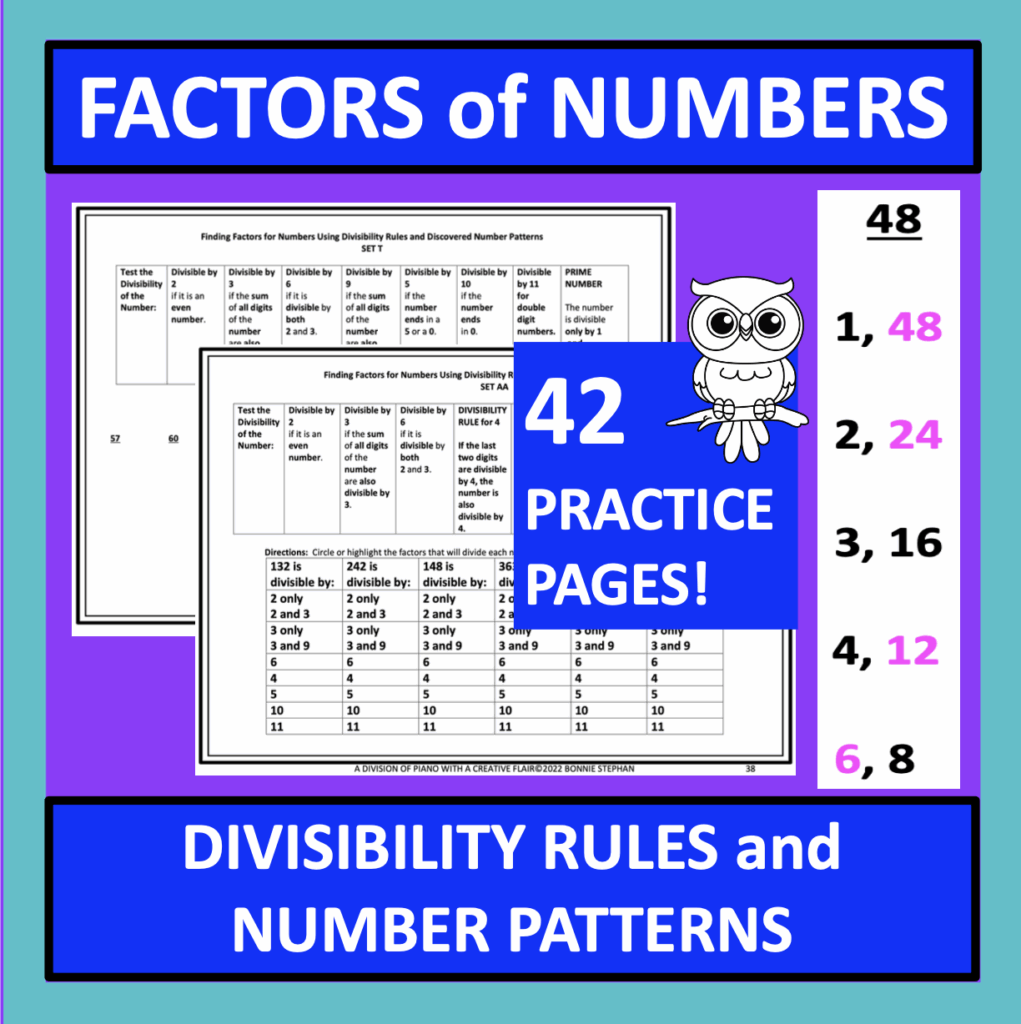
Are you looking for practice pages for students to practice listing factors? Check out the following.
https://www.teacherspayteachers.com/Product/How-to-EASILY-Simplify-Radicals-9764389

Other Related Posts

Looking for More Materials?
Click the button below to view more of my educational resources!