Do you struggle to teach fraction operations effectively? Keep reading! Learn one simple strategy that will make every operation easier.
#1 – Fraction Operations
Do you ever feel beaten down before you even begin teaching fraction operations with whole and mixed numbers? Do you have nightmares about past teaching experiences on the subject? Are the multiple strategies for completing a fraction operation with mixed numbers way beyond overwhelming? If so, this post is for you! I want to share a strategy that will boost your confidence as you approach this challenging topic! Let’s go!
#2 – Common Mistakes Students Make
Now, let’s recognize common mistakes students make when solving fraction operations with mixed numbers. Below are two examples.
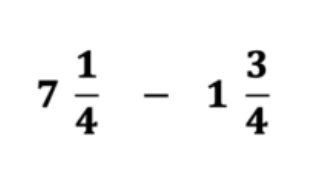
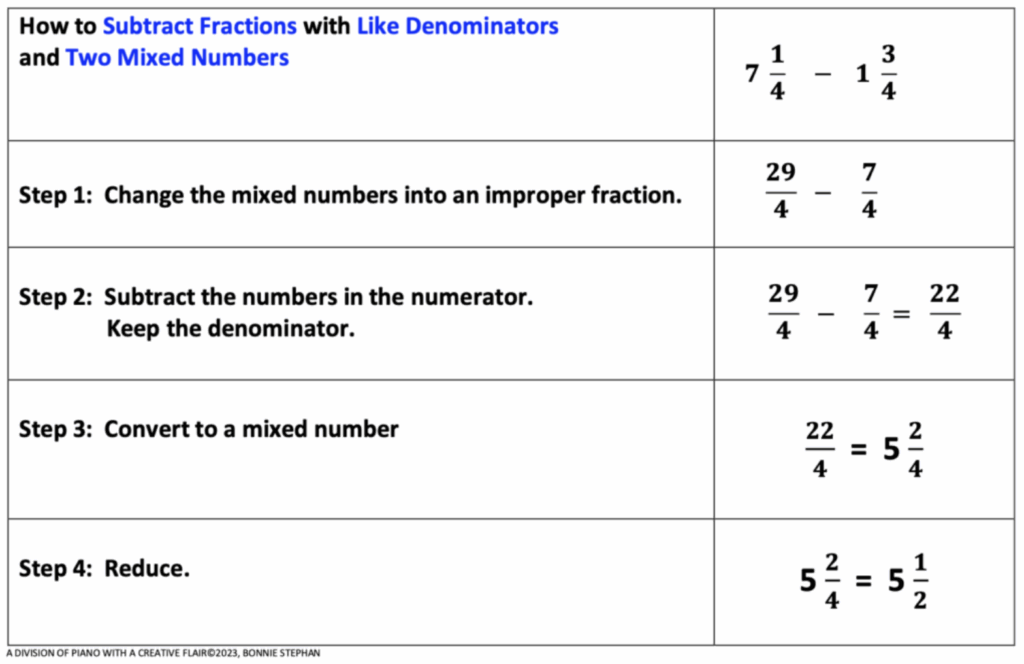
First, the problem above is an example that causes panic for many students. They subtract the numbers 7 and 1. When faced with subtracting 3 from 1, their panic button goes off as they wonder how to subtract 3 from 1.
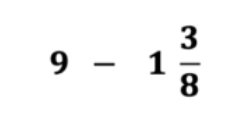
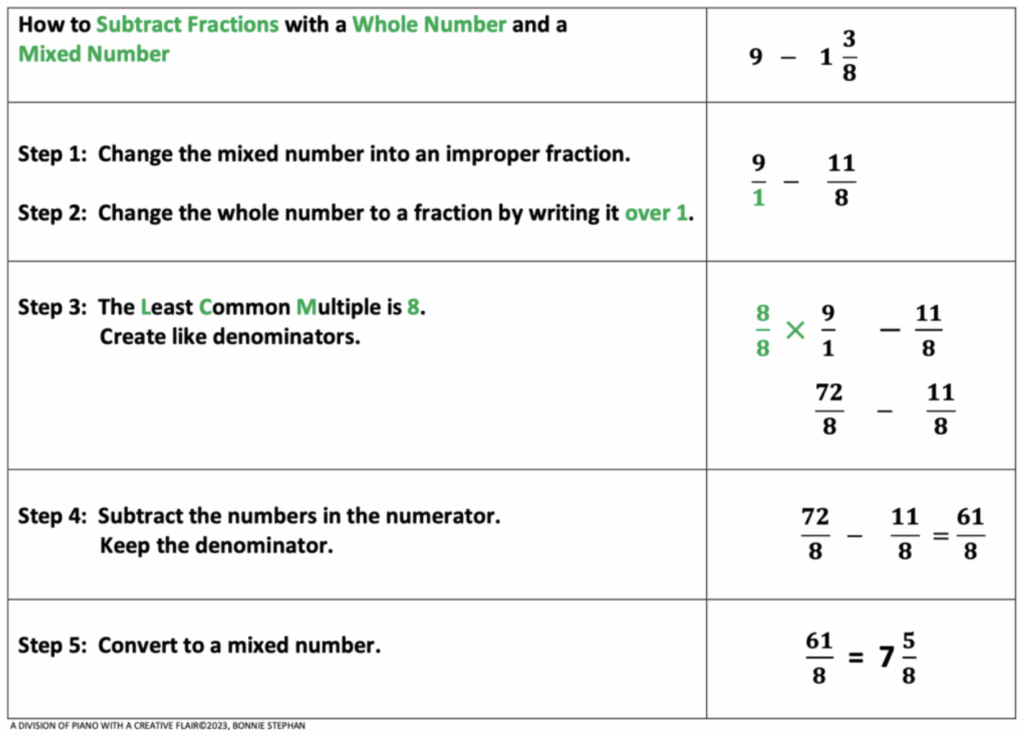
Second, when subtracting a mixed number from a whole number, students wonder where to begin. Some students may subtract 1 from 9 and conclude that the answer is 8 3/8 vs. 61/8 = 7 5/8.
Third, as students continue to multiply and divide with mixed and whole numbers, student confusion and frustration escalate.
#3 – The Key Strategy!
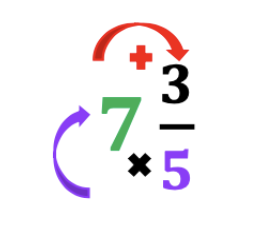
Furthermore, what is the key strategy that boosts my students’ confidence with fraction operations involving whole and mixed numbers? Change each whole and mixed number into an improper fraction for every type of fraction operation! Common mistakes disappear! Let’s look at some examples.
A. Subtract Fractions with Mixed Numbers
First, notice that the problem includes two mixed numbers. In this case, both numbers will be changed into mixed numbers. Notice how much easier it is to subtract. This step is followed by turning the fraction into a mixed number and reducing the final answer to the lowest terms.
B. Fraction Operations with Mixed Numbers
Just as above, the mixed number is turned into an improper fraction. The whole number turns into a fraction of 9/1. By placing a one in the denominator of the whole number, both fractions line up evenly. As the denominators are different, students will proceed to use the L.C.M. to solve the operation, turn the improper fraction into a mixed number, and reduce to the lowest terms if needed.
Likewise, the same strategy can be used when adding, multiplying, and dividing fractions.
#4 – Other Words of Wisdom
Likewise, before introducing this super strategy, students need to be proficient in the following skills:
- 1. Conceptualize fractions through the use of models: Part, whole, mixed numbers, proper, and improper fractions
2. Change between mixed numbers and improper fractions
3. Reduce fractions
4. Perform fraction operations with proper and improper fractions
Conclusion
In conclusion, you can now see how much easier it can be to solve ALL fraction operations with mixed and whole numbers!
- 1. Change mixed and whole numbers into improper fractions
2. Complete the operation: addition, subtraction, multiplication, and division
3. Change answers into mixed numbers if needed
4. Reduce if needed
Done!
Looking for More Materials?
Click the button below to view more of my educational resources!
Other Related Posts