
Discover ways to provide success with integer operations for students with special abilities.
Who are the Special Students?
Do you remember your first experience with integers? It reminds me of an aerobics class I visited. Sure, the slow stretch at the beginning may be fine, but then the music, directional terms, and moves speed up! I was lucky enough to escape unscathed. This is similar to the experience of our special students learning integer operations. Strategy? Integer labs.
Therefore, let’s consider who these special students are.
- 1. Students whose first language is not English
- 2. Students who struggle with language processing challenges
- 3. Students with visual learning abilities
- 4. Students who already think that they can’t do math
Integer Introduction Lab # 1
First, provide hands-on examples. My favorite hands-on example is with an outdoor thermometer and a bowl of water.
- 1. Students read the initial temperature and record it on notebook paper.
- 2. Add ice to the bowl.
- 3. Provide students with visual cues, such as thumbs down, and easy terms, such as “down,” to describe the result of adding ice to the bowl.
- 4. Students record the new temperature.
- 5. Students record the distance between the original and new temperature in degrees.
- 6. Next, repeat the process by removing any remaining ice and adding warm water.
- 7. Students review the recorded data. For each temperature change, they will decide what operation is associated with each change in the experiment.

Integer Lab # 2
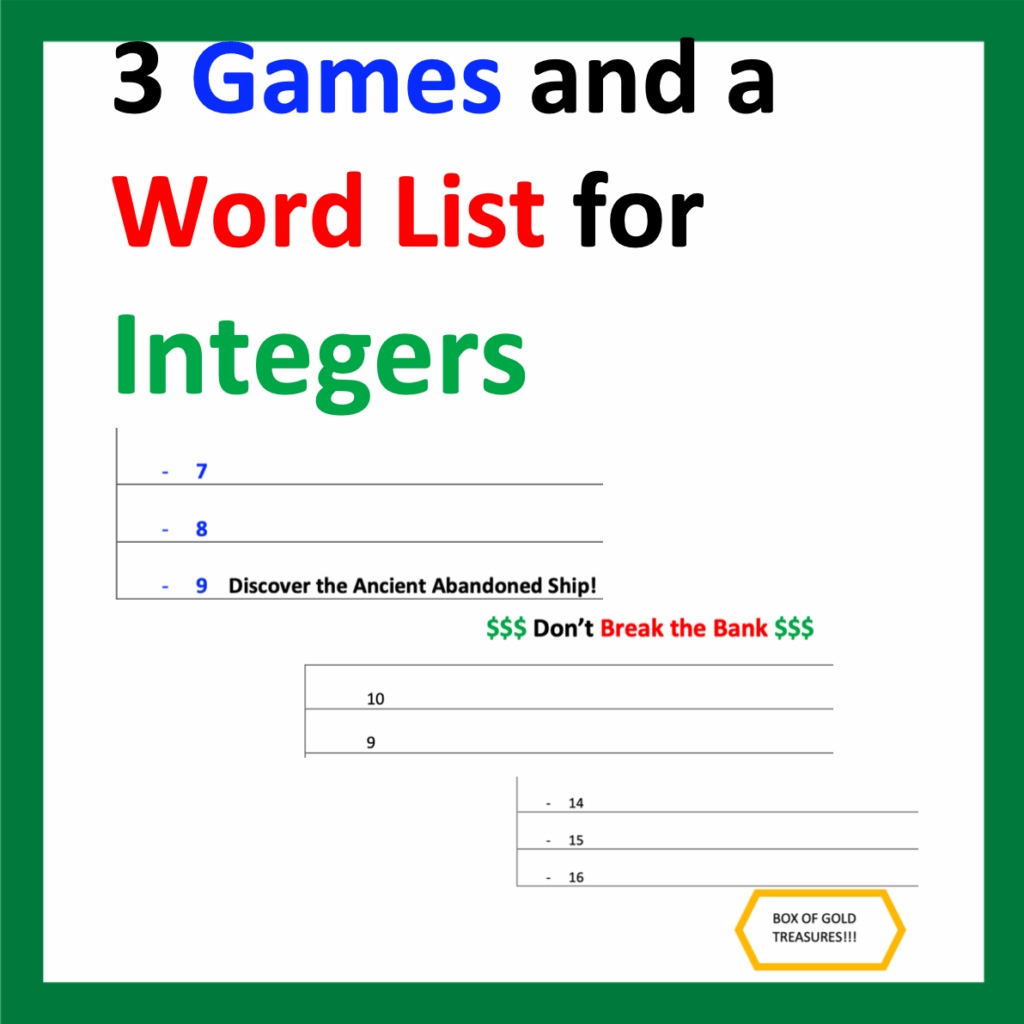
Second, relate integers to a bank account, using positive signs for deposits and negative signs for spending. This works well with pairs or small groups with mixed abilities.
- 1. Each pair or small group begins with the same amount in their “bank account.” Students are given fake dollar bills to add or remove from their “bank” account. Students record their starting balance at the top of a page of notebook paper.
- 2. Each pair or small group will use two dice. One with numbers and another with negative and positive signs.
- 3. Next, students will toss both dice.
- 4. Then, students write the sign and number beneath the initial amount in their account. If the initial amount is $ 20, and the dice result in -5, this amount is written underneath 20, and a new amount of $15 written. Students will remove 5 of the dollar bills from their “bank”.
*When the account value is less than zero, inform students that this amount is how much they will owe the bank. Explain that this amount represents how much they overspent. - After students are provided with practice, a timer is set for 10 minutes.
- 5. The students toss dice and calculate new values. At the end of the 10 minutes, students record the total amount in the “bank”. The students with the greatest positive value win.

Keep it Simple
Third, once students begin to grasp a general concept of integers and how integers can be applied to real-life situations they will be prepared to make connections between these experiences and integer operations.
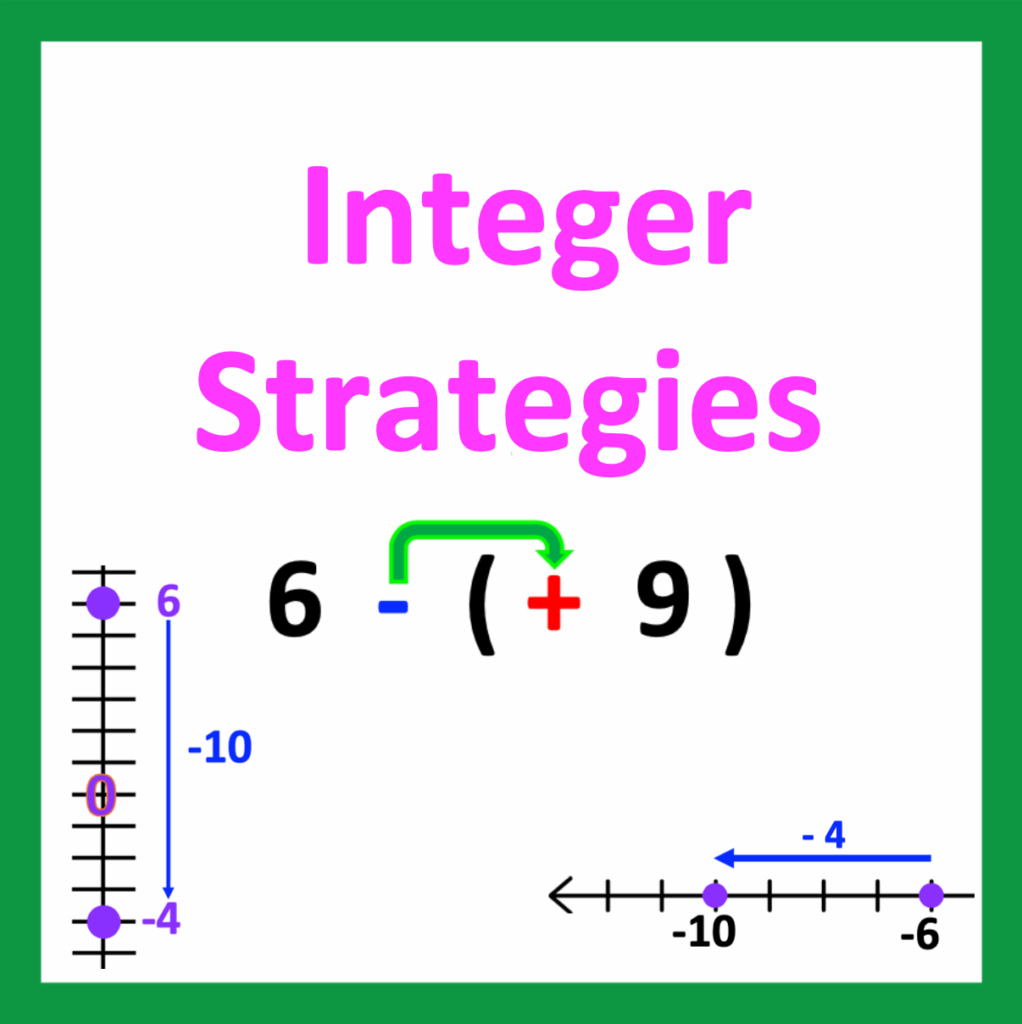
On the other hand, it is important to recognize the importance of simple terminology and visuals. Number lines are an excellent source for this concept. Begin with a discussion related to the integer labs examples and apply these experiences with number lines.
For example, compare and contrast the similarities and differences between the thermometer and a vertical numberline. A horizontal number line works well for examples involving the distance between starting and ending points.
Conclusion
In conclusion, the use of integer labs with real-life situations provide a foundation from which to build deeper understanding for integer operations.
Related Resources:
https://www.teacherspayteachers.com/Product/Integer-Strategies-Posters-and-Practice-11444768
Other Related Posts

Looking for More Materials?
Click the button below to view more of my educational resources!